Balance Bike Benefits, Set-up and How to Teach Your Child to Ride
Posted by Jason - 2023-03-11T00:00:00.000+08:00 - 2025 Balance Bike recommendation
Last updated: 7 October 2026
The main benefit of a balance bike is that children learn to balance first, and they tend to move on to a pedal bike sooner. In a Portuguese survey of 2,005 responses, the 54 people who went straight from a balance bike to a pedal bike learned to cycle at 4.2 years on average, against about 6 for the 630 who started with training wheels. Most balance bikes we stock are sized from age 2.
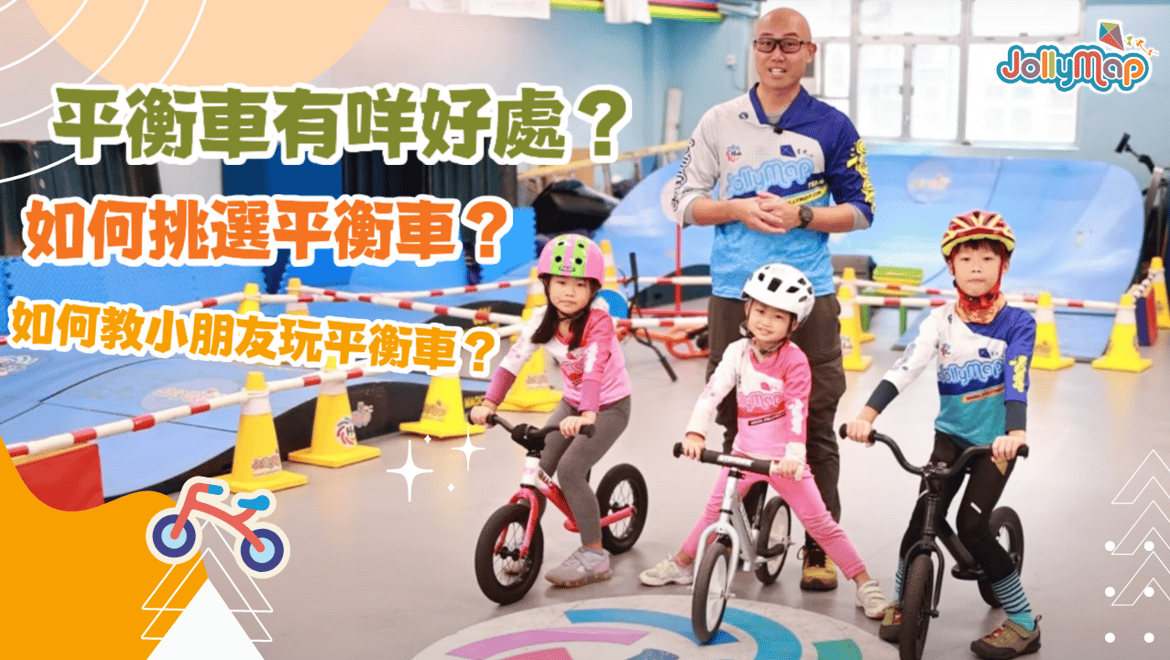
This guide is based on the balance bike tutorial Jollymap filmed in March 2023 (in Cantonese), updated in October 2026 with research findings, a fit chart and bikes currently in stock in Hong Kong.
Key points
- Benefit: balance comes first. In the Portuguese survey, those who went straight from a balance bike to a pedal bike (54 people) learned to cycle at 4.2 years on average, those who used training wheels (630) at 6.0 (a link, not proof of cause).
- Starting age: the Papa Bike and VoomVoom balance bikes we stock are both rated for ages 2 to 5; the same research team suggests children seem ready at about two and a half.
- Fit: set the saddle so both feet sit flat on the ground with knees slightly bent; our rule of thumb is a bike no heavier than a third of the child's weight.
- Moving on: once your child glides with both feet up, steers and stops, and is about 95–120 cm tall, look at a 14 or 16 inch bike.
What are the benefits of a balance bike?
A balance bike teaches balance from day one instead of relying on stabilisers. Research has found that children who went straight from a balance bike to a pedal bike learned to ride earlier on average, and because the bike is light and their feet can touch the ground at any time, beginners feel more secure.

Learning to pedal sooner
The 2022 study by Mercê and colleagues collected 2,005 online survey responses in Portugal. The 54 who went straight from a balance bike to a pedal bike learned to ride independently at an average of 4.16 years, compared with 5.97 years for the 630 who used training wheels and 7.27 years for the 404 who started on a pedal bike alone. Those who used a balance bike and then training wheels (53 people) learned at 4.63. It is a look-back survey and the authors themselves urge caution, so treat it as an association rather than proof.
Light and low, so less scary
With no pedals, chain or stabilisers, a balance bike can be very light: the Papa Bike Runner Pro Plus we stock weighs about 2.77 kg. The saddle is low enough for both feet to rest flat on the ground, so children set their own pace and stop simply by putting their feet down.
Motor skills: some evidence, still limited
A 2024 Spanish study by Navarro-Patón and colleagues followed 98 preschoolers (average age about 3.9). The 59 who took a nine-week balance bike programme, three 50-minute sessions a week, started with lower scores than the control group for manual dexterity and balance; after nine weeks the difference was no longer statistically significant. It was a small, non-randomised study. Our earlier version of this article claimed benefits for handwriting and language, which we could not find research to support, so we have removed them.

What age can a child start on a balance bike?
Most balance bikes start at age 2. The Papa Bike Runner Pro Plus and VoomVoom 12 inch Gen 3 we stock are both rated for ages 2 to 5, and the Portuguese researchers suggest children seem ready at about two and a half. Height and inside leg matter more than age, because children of the same age vary a lot in size. Starting at 5 or 6 is fine too (see the FAQ).

How do you choose and set up a balance bike?
Check seat height and weight first. With the saddle at its lowest, it should sit below your child's inside leg so both feet rest flat with knees slightly bent, and the bike should weigh no more than about a third of your child's weight.
Seat height
Inside leg is the distance from the floor to the crotch; our kids' bike size chart explains how to measure it. Fit ranges vary a lot between balance bikes, even at the same wheel size: our product pages list the 12 inch Papa Bike Runner Pro Plus for riders 85–115 cm with a 34 to 44 cm seat, and the 12 inch VoomVoom Gen 3 for riders 89–105 cm. So check the seat height and rider height, not just the wheel size.


Weight
Our video uses a one-third rule, and Cannondale says the Kids Trail Balance follows its "Kid-Correct Weight" rule of no more than 30 to 40 percent of the child's weight. A 14 kg child, for example, would want a bike of about 4.7 kg or less.
Footrest and handlebar height
A footrest gives children somewhere to put their feet once they can glide, which also helps later when they learn to lift their feet onto pedals. Our video recommends keeping the handlebar fairly low rather than high: a high bar shifts the weight backwards and makes it harder to hold on and steer.
Helmet from the first ride
Hong Kong's Transport Department advises a properly sized helmet that meets an international standard such as EN 1078 or CPSC 1203. Our video also suggests gloves, knee and elbow pads, and putting them on from day one so the habit sticks. For helmet law and choosing a helmet, see Bike Helmet Law in Hong Kong: 2026 Update.

How do you teach a child to ride a balance bike?
Start by walking the bike, then sit and take small steps, then longer strides, and finally glide with both feet up. Our video says a child who can glide three to five metres has got the knack.
- Walk the bike: if your child is nervous about sitting on it, let them push it along first and get used to it.
- Pick it up and sit down: lay the bike flat, have your child step over it and lift it up, then sit on the saddle.
- Small steps, then big strides: if you help, hold their shoulders or under the arms, not the bike, or they cannot tell how much you are doing. Games help: a low bar to duck under gets them sitting, footprints on the ground get them striding.
- Feet up: once they can stride and glide a few metres, try one foot on the footrest, then the other, then both.

If your child loses interest, do not decide too early that they dislike it. Keep it fun, let them decorate the bike with stickers or take a favourite toy along, and ride alongside them: young children learn more from watching than from instructions. Riding with other children also helps, for example on a group outing or in a balance bike class.
When should a child move from a balance bike to a pedal bike?
Go by ability, not a fixed age: when your child glides steadily with feet up and can steer and stop, they are ready. In the Portuguese survey, those who went straight from a balance bike to a pedal bike learned at about 4.2 on average.

Based on our size chart, a 14 inch bike suits roughly 95–115 cm and a 16 inch roughly 100–120 cm. For the next step, see our guide to teaching kids to ride a bike (in Chinese).
Balance bikes in stock at Jollymap
All three were in stock online when we checked on 7 October 2026. Specs are from our product pages, except Cannondale's height range, which comes from the brand's website. Strider balance bikes were sold out online at the time.
| Model | Weight | Rider height | Seat height | Best for | Link |
|---|---|---|---|---|---|
| Papa Bike Runner Pro Plus 12" | about 2.77 kg | 85–115 cm | 34–44 cm | Ages 2–5, light with air tyres fitted | 7 colours in stock |
| Cannondale Trail 12" balance bike | not listed | 94–107 cm (current model) | not listed | A big-brand alloy frame | Turquoise, purple |
| VoomVoom 12" Gen 3 | 3 kg | 89–105 cm | not listed | Ages 2–5, entry level | Blue in stock |
Papa Bike Runner Pro Plus: 2.77 kg with air tyres

A 6061 aluminium frame at about 2.77 kg, rated for ages 2 to 5 and 85–115 cm, with a tool-free seat clamp. It comes with CST air tyres and sealed-bearing hubs. The catch: air tyres can puncture and need pumping, and no hand brake is listed.
See the Papa Bike Runner Pro Plus colours and specs
Cannondale Trail 12: the single-sided Lefty look

An alloy frame with Cannondale's Lil' Lefty single-sided fork; Cannondale lists the current Kids Trail Balance for riders 94–107 cm. The catch: our product page does not list weight or seat height, no hand brake is visible in our product photos, and the batch we sell may differ slightly from the current model, so ask us for the seat height before you buy.
See the Cannondale balance bike in turquoise and purple
VoomVoom 12 Gen 3: a 3 kg starter bike

Alloy frame, air tyres and a 130-degree steering limiter, at 3 kg, for ages 2 to 5 and 89–105 cm. The catch: the fork is steel, only blue is left, and the 105 cm upper limit means taller children will outgrow it sooner.
See the VoomVoom Gen 3 in blue
More models: balance bikes at Jollymap. Feel free to contact us to check sizing before you buy.
FAQ
Is a balance bike better than training wheels?
Current research leans towards the balance bike. In a 2025 Portuguese study, 50 non-riders averaging 5.8 years had six sessions on either balance bikes or bikes with training wheels, then four on ordinary bikes: every child in the balance bike group learned to ride, against about 77 percent with training wheels. The sample was small, but the result matches the 2022 survey.
Is 5 or 6 too old to start?
No. The children in that study averaged 5.8 years, and all of the balance bike group learned. Older children just need to check the rider height and seat height; the Papa Bike Runner Pro Plus we stock, for example, fits riders 85–115 cm.
Does a balance bike need a brake?
Not essential, as young children usually stop with their feet. Cannondale says a rear hand brake teaches skills they will need on bigger bikes; among our stock, the VoomVoom Gen 3 takes an optional rear disc brake.
Should children wear a helmet on a balance bike?
Yes. The Transport Department advises a helmet meeting an international standard, and balance bikes can tip over too. Hong Kong has no law requiring cycle helmets yet.
Further reading
- Kids' bike size chart: wheel size by height, age and inside leg
- Eight popular kids' and teenagers' bike brands
- Bike Helmet Law in Hong Kong: 2026 Update and How to Choose a Helmet
- Teaching kids to ride a bike: 8 tips (in Chinese)
Update log: 7 October 2026. First English version, written from the updated Chinese article: added Portuguese and Spanish balance bike research, three charts, fit and weight figures, when to move to a pedal bike, FAQ and in-stock bikes; removed developmental claims without research support and replaced sold-out Strider links.
Sources
- Jollymap YouTube: balance bike benefits, set-up and teaching (Cantonese, 11 March 2023)
- Mercê C. et al. Learning to Cycle: From Training Wheels to Balance Bike. IJERPH 2022;19(3):1814
- Mercê C. et al. Learning to Cycle: Body Composition and Balance Challenges in Balance Bikes Versus Training Wheels. J Funct Morphol Kinesiol 2025;10(1):53
- Navarro-Patón R. et al. Is It Possible to Improve Motor Competence through a Structured Balance Bike Program in Preschool Children Aged 3 to 6 Years? Sports 2024;12(3):83
- Cannondale: Kids Trail Balance
- Transport Department Cycling Information Centre: safety tips
- Jollymap product pages: Papa Bike Runner Pro Plus (2056), Cannondale Trail 12 balance bike (99), VoomVoom 12 Gen 3 (4599), read 7 October 2026


