How to Teach a Child to Ride a Bike: 8 Steps (Adults Too)
Posted by Jason - 2025-07-08T00:00:00.000+08:00 - 2025 Kid Bikes Recommendation
Last updated: 7 October 2026 (added places to practise in Hong Kong, research data, two charts, FAQs and in-stock bike suggestions)
The quickest way to learn to ride a bike is balance first, pedals later. Lower the saddle until both feet sit flat on the ground, take the pedals off and let the rider glide like on a balance bike, then refit the pedals once the gliding is steady. It works for children and adults, needs no training wheels, and a helmet goes on from day one.
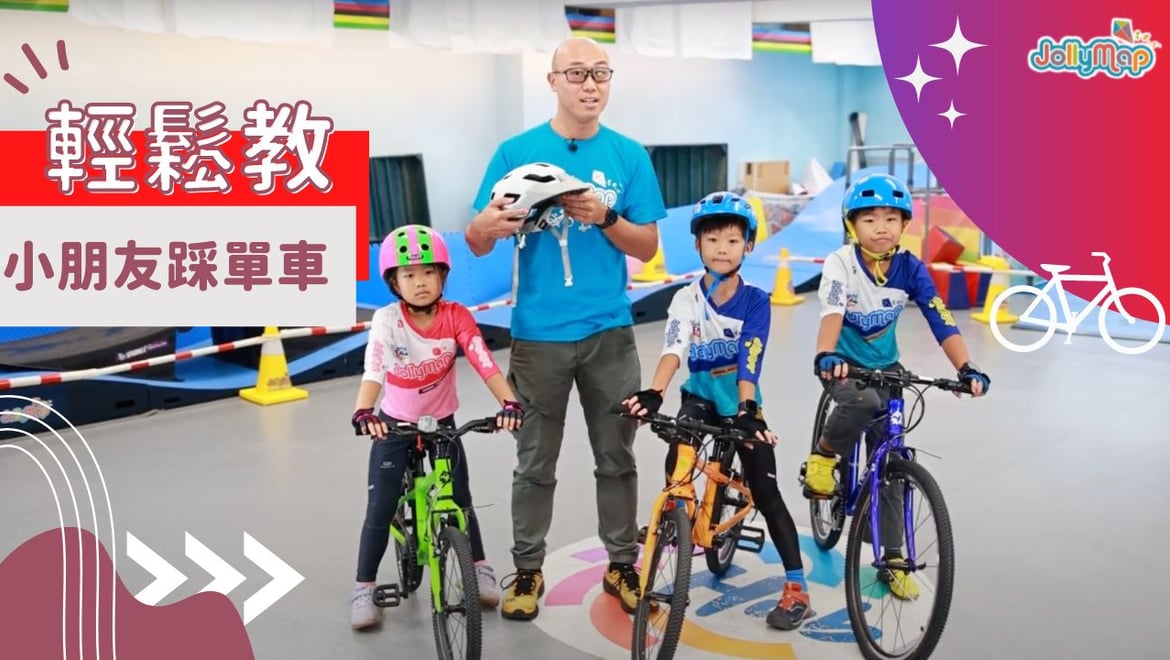
The eight steps below come from a Jollymap teaching video filmed in 2023 (embedded below, in Cantonese). We have put them in the order a beginner actually needs them and added where to practise in Hong Kong, what the research says, and which bikes make the job easier.
Key points
- In a Portuguese survey of 2,005 riders (Mercê et al., 2022), those who went straight from a balance bike to a pedal bike (54 people) learnt to ride at 4.16 years on average; those who used training wheels (630) learnt at 5.97.
- Weight matters: 16-inch kids' bikes range from about 6.2 kg to over 9 kg. Against the WHO median weight of about 20 kg for a six-year-old, 9 kg is about 45% of the child's body weight.
- Hold the child's arm or shoulder, not the saddle or handlebars, so they can feel how much help they are getting.
- The LCSD opens 24 parks for toddlers on balance bikes and lists 25 cycling venues; under-11s need an adult with them to cycle on a road (Transport Department).

What do you need before the first lesson?
Step 1: a light bike that fits
A bike that is too big keeps the child's feet off the ground and their confidence low; one that is too heavy is hard to start and hard to hold up. In the video the test is simple: seated, both feet flat on the ground, knees clear of the handlebar, hands resting naturally on the grips. Cycling UK also lowers the saddle so both feet can go down flat. A common pattern we see in our shop: children who can already ride are fine on tiptoe, while beginners want most or all of the foot on the ground.

Weight is about the ratio. Among 16-inch bikes, the Minivelo 16 weighs 6.2 kg (our shop spec) and the Frog 44 6.39 kg (Frog figure), while some geared or folding models are heavier and can top 9 kg. The WHO growth reference puts the median six-year-old boy at 20.5 kg and girl at 20.2 kg, so by our own calculation a 9 kg bike is about 45% of the rider's weight; a 6 kg bike is about 30%. For sizing by height, see our kids' bike size chart.
Step 2: helmet always, gloves and pads help
Helmets are not yet compulsory for cyclists in Hong Kong, but the Transport Department's Cycling Information Centre advises a brightly coloured, well-fitting helmet that meets an international standard such as EN 1078 or AS/NZS 2063. Start on day one and the helmet simply becomes part of riding. More in our Hong Kong helmet law and buying guide. Gloves soak up sweaty palms and protect the hands in a fall; browse kids' helmets and knee and elbow pads.

Step 3: two quick warm-ups
The video picks out the core, which does the work in balancing and turning, and the hamstrings, which bring the pedal back up. Warm-ups: step forward with alternate feet while twisting the upper body the other way, then stand with hands behind the bottom and kick each heel up to touch the palms a few times.

How do you teach balance first?
Step 4: split balance from pedalling
Riding means learning two things at once, balancing and pedalling. Gearing makes it harder: on a Frog 44 the 32-tooth chainring drives an 18-tooth sprocket, so one turn of the pedals spins the rear wheel about 1.8 times. Starts take more effort and speed builds quickly. So the video practises the two skills separately.

Research points the same way. Mercê and colleagues surveyed 2,005 people in Portugal born from the 1960s onwards (some answered by parents) about how they learnt: balance bike then straight to a pedal bike (54 people), 4.16 years; training wheels, 5.97; straight onto a pedal bike, 7.27. Those who used a balance bike and then training wheels (53 people) learnt at 4.63. A Dutch parent survey of 166 children (Blommenstein and van der Kamp, 2022) found the same direction. Both rely on memory, which the authors flag, so they show a link rather than proof.
Step 5: pedals off, glide like a balance bike
A balance bike is the easy option; otherwise take the pedals off an ordinary bike. Lower the saddle so the knees stay slightly bent, and get the rider to look ahead, not down at the front wheel. The video has the parent stand a little way off so the child walks the bike towards them, small steps first, then longer strides, then feet up and glide. Cycling UK suggests a gentle downhill and refitting the pedals once the rider can keep their feet up for 10 to 15 seconds.

Where should a parent hold on?
Not the saddle or handlebars: holding the bike works like training wheels, and the child cannot tell how much you are helping. Hold an arm or shoulder instead; Cycling UK's guide suggests gently holding them under the arms or by the middle of the back of their top. A light hand on the back is enough if the child just wants to know you are there.

When do the pedals go back on?
Step 6: scoot one-footed, pedal on three
Refit the pedals and, if the bike has gears, pick a low one. Scoot with both feet first, then one foot on a pedal while the other pushes. In the video, once the rider can scoot eight to ten metres like this, count "one, two, three" together and put both feet up on the third or fourth push. Cycling UK starts with one pedal raised and a push down on it. Expect a few attempts.

How do you teach turning and stopping?
Step 7: look at the exit, lean with the body
Turning is more about shifting weight than twisting the bars, and about the eyes: stare at the corner and you ride into it, so look through to where you want to come out. A game from the video: stand in the middle of an open space and have the child circle you while watching you, tightening the circle, then switching direction.

Step 8: walk the bike and try the brakes
Balance-bike graduates stop with their feet, which stops working at pedal-bike speed. The video separates the skills: off the bike, walk it and squeeze each brake to feel how hard it bites, learning which lever is front and rear. Its advice is rear brake to slow down, both to stop. Note that the American Academy of Pediatrics suggests a first bike with a foot (coaster) brake, as young hands may not manage hand brakes; both 16-inch bikes below (Minivelo 16 and Frog 44) use hand-operated V-brakes, so look for short-reach levers such as the Tektro levers on the Frog 44.

Where can you learn to ride in Hong Kong?
Start somewhere flat and quiet, not on a cycle track. Details below are from the Leisure and Cultural Services Department (LCSD) and Transport Department websites; check opening hours before you go.

The LCSD's balance bike parks list has 24 venues in 17 districts where toddlers can ride balance bikes under adult supervision, including Sun Yat Sen Memorial Park, Wan Chai Park, Sham Shui Po Park (Stage I), Tseung Kwan O Waterfront Park and Ma On Shan Park. Its cycling tracks and grounds list has 25 venues in 12 districts. Good starting points:
| Venue | What the LCSD lists | Note |
|---|---|---|
| Tsuen Wan Park | 2,800 m² children's cycling track | 7am to 11pm |
| Sha Tin Road Safety Park | Children's cycling track and area | Wheels no larger than 1 ft (30 cm) |
| Tseung Kwan O South Park | Children's cycling track and area | Bike rental kiosk |
| Po Kong Village Road Park | Cycling area, 1 km raised cycle track | Helmet required on the raised track |
| Cycling hubs: Sheung Shui, University Station, Tsuen Wan Waterfront, Tuen Mun, Tin Shui Wai, Yuen Long Town | Cycling practice grounds | Sheung Shui, University Station, Tin Shui Wai and Yuen Long Town have Auxiliary Medical Service first-aid posts on Saturday afternoons, Sundays and public holidays |
The Transport Department's rules: children under 11 must be with an adult to cycle on a road, use the cycle track where there is one, and never ride on the pavement. Get starting, turning and braking sorted in a park before heading for the cycle tracks.
Which bike should a beginner use?
A balance bike for balance, then a light 16-inch bike for pedalling, is the usual pairing. All three below were in stock on 7 October 2026.
| Model | Type | Weight | Fits | Product page |
|---|---|---|---|---|
| Papa Bike Runner Pro Plus | 12-inch balance bike | About 2.77 kg (brand) | Ages 2–5, 85–115 cm | See 7 colours in stock |
| Minivelo 16 | 16-inch single speed | 6.2 kg (shop spec) | 100–130 cm | See 4 colours |
| Frog 44 | 16-inch single speed | 6.39 kg (Frog) | Ages 4–5, inside leg 40–53 cm | See 5 colours in stock |
Papa Bike Runner Pro Plus: balance from age two

Alloy frame, about 2.77 kg, saddle 34–44 cm with a quick release and CST air tyres (brand figures). Light enough for most toddlers to pick up after a fall. Limitation: air tyres grip well but can puncture and need topping up.
See the Runner Pro Plus colours and sizing
Minivelo 16: the easy first pedal bike

6.2 kg (our spec), single speed with V-brakes, saddle 46–54 cm, for riders 100–130 cm tall; all four colours were in stock. Limitation: with a single speed, hills are hard work, so families on steep streets should expect some pushing; it also uses hand brakes, so practise step 8 first if your child has not used them. The weight and saddle figures are our own spec.
See the Minivelo 16 colours and the 14 to 24-inch range
Frog 44: brakes small hands can reach

6.39 kg with pedals (Frog figure), Tektro V-brakes with short-reach levers and 89 mm cranks, for ages 4–5 with a 40–53 cm inside leg. Limitation: available while current stock lasts; green had sold out when we checked.
See the Frog 44 colours and full spec
For more brands, see eight popular kids' bike brands. Not sure about size? Get in touch before you buy.
FAQ
Can adults learn to ride the same way?
Yes. Cycling UK's guide for adult learners uses the same order: sit with both feet on the ground, push off and lift the feet to glide, and only start pedalling once balancing unaided for a short distance. Adults can use the practice grounds at the LCSD cycling hubs (LCSD lists no age limit; Sha Tin Road Safety Park only takes bikes with wheels up to 1 ft); quiet times are easier.
What age can children learn to ride?
There is no fixed age; balance and confidence matter more. In the Portuguese study the group that went straight from a balance bike to a pedal bike learnt at 4.16 years on average and the training-wheels group at 5.97; a Dutch study found about 3.5 years for balance-bike riders. Both are recall surveys, so treat them as a guide.
Are training wheels a good idea?
We would skip them. Training wheels stop the bike leaning, so the child never learns to balance and has to start again when they come off. In the Portuguese study the training-wheels group learnt about 1.8 years later than those who went straight from a balance bike to a pedal bike.
Can beginners practise on a cycle track?
Not until they can start, turn and brake. Cycle tracks carry other riders and pedestrians, so use a park cycling area first; under-11s riding on a road must be with an adult (Transport Department).
Further reading
- Balance bike benefits and set-up (in Chinese)
- Kids' bike size chart: wheel size by height, age and inside leg
- Eight popular kids' and teen bike brands
- Bike helmet law in Hong Kong: 2026 update
Update log: 7 October 2026. Reordered the eight steps with question-style headings; added Hong Kong practice venues (LCSD balance bike parks and cycling grounds, Transport Department rules), Portuguese and Dutch research, two charts, FAQs and in-stock bike suggestions; removed an unsourced body-weight figure and broken short links; first full English version.
Sources
- Jollymap YouTube: teaching a child to ride in 8 steps (January 2023, Cantonese)
- Mercê C. et al., Learning to Cycle: From Training Wheels to Balance Bike, IJERPH 19(3):1814, 2022
- Blommenstein B., van der Kamp J., Mastering balance, British Journal of Developmental Psychology, 2022
- Cycling UK: Ditching your child's stabilisers when learning to ride
- Cycling UK: How to teach your child to ride a bike
- Cycling UK: How to teach an adult to ride a bike
- American Academy of Pediatrics, HealthyChildren.org: Bicycle Safety: Myths and Facts (updated July 2022)
- World Health Organization: weight-for-age reference, 5–10 years
- Transport Department Cycling Information Centre: cycling rules and safety tips
- LCSD: Opening up parks for toddlers to play balance bikes (revised 26 May 2026)
- LCSD: Cycling tracks and grounds (read 7 October 2026)
- Jollymap product pages: Papa Bike Runner Pro Plus (2056), Minivelo 16 (1270), Frog 44 (833), read 7 October 2026


